Which months are best to paint a house exterior in Nashville?
Here’s the whole year at a glance, judged against what exterior paint actually needs, using NOAA’s 30-year climate averages for Nashville.
- Best
- Good
- Workable with care
- Limited
See the climate data behind each verdict
| Month | Avg high / low | Rainy days | Days 90°F+ | Freeze nights | Verdict |
|---|---|---|---|---|---|
| Jan | 49.1 / 30.1°F | 10.8 | 0 | 18.8 | Limited |
| Feb | 53.8 / 33.0°F | 10.9 | 0 | 14.2 | Limited |
| Mar | 62.7 / 40.2°F | 11.6 | 0 | 7.4 | Workable with care |
| Apr | 72.6 / 48.9°F | 11.2 | 0 | 0.9 | Good |
| May | 80.4 / 58.3°F | 11.6 | 2.0 | 0 | Good |
| Jun | 87.7 / 66.4°F | 10.7 | 10.8 | 0 | Good |
| Jul | 90.9 / 70.5°F | 10.3 | 18.2 | 0 | Workable with care |
| Aug | 90.4 / 69.0°F | 9.4 | 15.9 | 0 | Workable with care |
| Sep | 84.4 / 61.8°F | 7.8 | 6.8 | 0 | Best |
| Oct | 73.5 / 49.9°F | 8.4 | 0.4 | 0.7 | Best |
| Nov | 61.4 / 39.2°F | 9.0 | 0 | 8.4 | Workable with care |
| Dec | 52.2 / 33.3°F | 11.4 | 0 | 15.8 | Limited |
Climate data: NOAA NCEI 1991–2020 normals, Nashville International Airport.
How we scored the months. Today’s premium exterior paints (Sherwin-Williams Duration, Emerald, SuperPaint and Resilience; Benjamin Moore Aura and Regal Select) can go on down to 35°F, but the air and surface must stay above that for 48 hours, the surface must sit at least 5°F above the dew pointdew point The temperature at which moisture in the air turns into dew. The surface has to stay warmer than this so no moisture forms under the paint., and the paint needs one to three rain-free hours after application. Standard latex paints and many primers need 50°F, and paint sets up too fast above 80°F and shouldn’t go on in direct sun. Against those rules, a month is Limited when it averages more than 10 freezing nights; Workable with care when it averages some freezing nights or more than 12 days at 90°F or hotter; Best with nine or fewer rainy days; and Good with more.
Two caveats. First, these are 30-year averages, not forecasts: a Best month still has days nobody should paint, and a Limited month has warm afternoons. Second, if your painter is using a product that needs 50°F, the window narrows to roughly May through September, with April and October marginal.
Is fall or spring better for exterior painting in Middle Tennessee?
Fall, usually. September averages the fewest rainy days of the year and is the least active month for severe weather, and October gets the least rain. But spring has one card worth knowing: April has the driest afternoons of the year, so a dry spring week can be ideal. Spring’s counterweights are storms (the National Weather Service counts about two-thirds of Middle Tennessee’s tornadoes in March through May, most often in the late afternoon) and pollen, which we’ll come back to.
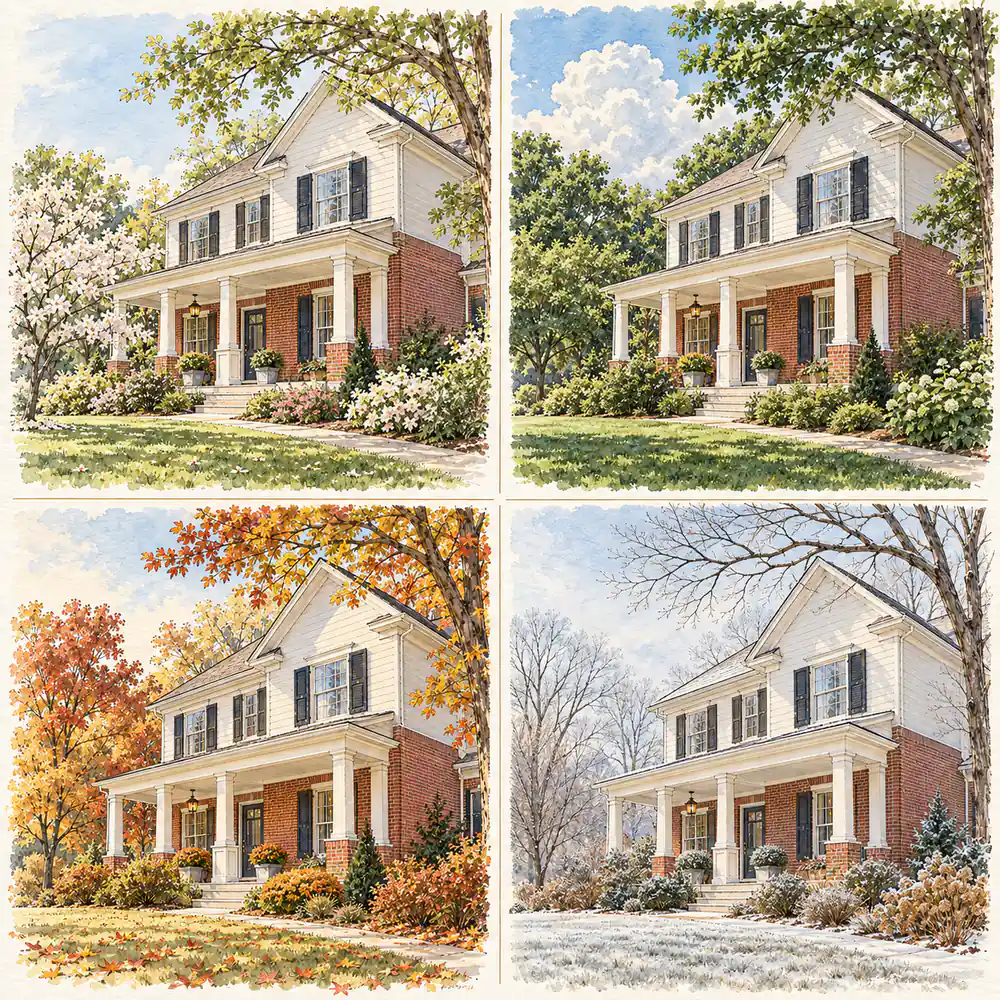
- Spring: mild, with pollen and storms
- Summer: hot afternoons, dewy mornings
- Fall: often the steadiest weather
- Winter: cold nights limit paint
How cold is too cold to paint a house in Nashville?
For today’s premium exterior acrylics, below 35°F, and remember the 48-hour rule: the air and the siding have to stay above that line for two days after the paint goes on. That’s what makes Nashville winters tricky. From December through February, the city averages 14 to 19 freezing nights a month. January afternoons still reach 50°F on about 14 days, but the nights between them usually fall below freezing. Cold also slows everything: at 35–45°F, Sherwin-Williams stretches the time between coats to 24–48 hours, and Behr suggests working only between about 10 a.m. and 2 p.m.
One note on the 35°F figure: it’s newer than most advice online. Benjamin Moore’s current data sheets list 35°F for Aura; the 40°F figure still quoted on some sites comes from an older sheet. The practical upshot hasn’t changed. Winter is interior season around here, which is when rooms, cabinets and trim get painted.
Can you paint a house exterior in a Nashville summer?
Yes, with discipline. July and August each bring roughly 16 to 18 days of 90°F or hotter, and paint sets up quickly above 80°F and shouldn’t go on in direct sun; Benjamin Moore’s sheets cap the surface at 100°F. So summer crews follow the shade around the house, start after the morning dew dries, and bank on the fact that summer also has the year’s lowest afternoon humidity and, outside of storms, decent rain odds. It’s workable. It’s just work.
Why does the dew point matter more than the forecast high?
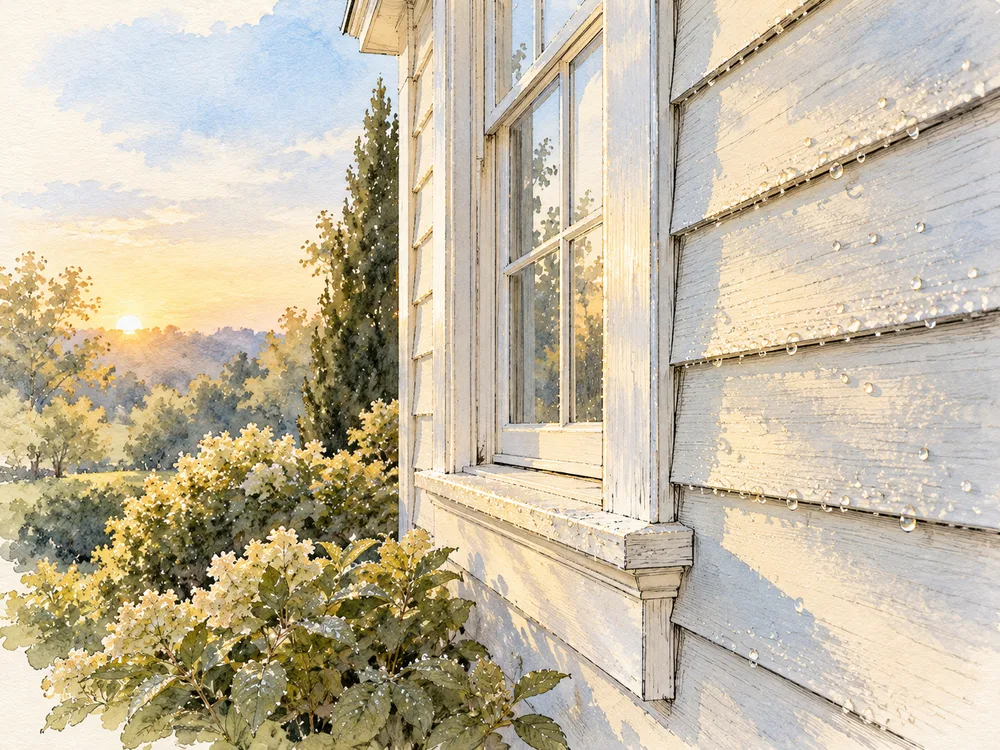
Because at dawn, siding is often damp with dew even when it looks dry, and the paint rules apply to the surface, not the air. From May through October, Nashville’s air at the coldest hour of a mid-month morning averages only 3.8–4.8°F above the dew point, and Sherwin-Williams requires the surface to stay at least 5°F above it. Siding at dawn can be colder than the air around it, too, so a thermometer reading alone can make a morning look safer than it is. By noon, the gap widens to 15–24°F in every month.
That’s why a good crew’s day starts a little later than you’d expect: the sun has to dry the walls before the first coat. And the day ends early enough for the paint to set before the evening dew. Sherwin-Williams says most products need at least four hours before moisture settles, and the cooler the day, the sooner painting should stop.
How long does fresh paint need before rain?
Less than you might fear, but it varies by product. Sherwin-Williams’ data sheets call for 2–3 rain-free hours for Duration, Emerald and SuperPaint, and just 1–1½ hours for Resilience, which is made for uncertain weather; its general guidance is four hours before moisture settles. Benjamin Moore’s sheets for Aura and Regal Select don’t state a figure at all. With Middle Tennessee’s pop-up afternoon storms, that rain window is what decides when the last coat of the day goes on.
And before the first coat, the wood itself has to be dry, not just the surface. Sherwin-Williams advises waiting at least a day after heavy rain and 24–48 hours after pressure washing; Benjamin Moore and Dunn-Edwards put the limit for painting exterior wood at 15% moisture, and the U.S. Forest Products Laboratory warns that painting wood above 20% invites blistering and peeling. A moisture meter answers this question better than any calendar.
Does pollen affect fresh exterior paint?
It’s a cleaning problem, not a paint problem. No paint maker we found says pollen harms fresh paint, but every one requires a clean surface, and Middle Tennessee’s pollen calendar is long. Metro Nashville Public Health puts tree pollen from about the first of March through May, grass from March until the first killing frost, and ragweed in the fall (Vanderbilt says mid-to-late August until the first frost). In spring especially, washing the house is part of preparation, and then the surface has to dry before painting, which is one more reason spring scheduling needs a little slack.
What do we watch the week of your job?
The month gets the attention, but the week does the work. Before and during an exterior project, here’s what a careful crew is actually tracking:
- 1. The 48-hour forecast of overnight lows against the product’s floor: 35°F for premium lines, 50°F for standard latex and many primers.
- 2. Surface temperature versus dew point at start time and in the last hours before dusk, with at least a 5°F margin.
- 3. Rain timing against the product’s rain-free window.
- 4. A moisture reading on the wood before any coating, and at least a day of drying after heavy rain.
- 5. Sun-side wall temperatures against the 100°F surface maximum, measured, not guessed.
- 6. Wind and pollen on days when horizontal surfaces are being coated.
This is also why we schedule exteriors the way we do: the date on the calendar is a plan, and the conditions on the day make the call.
How far ahead should you book an exterior painter in Nashville?
Several weeks ahead in spring and fall, by local companies’ own accounts. Nashville painting companies describe March through October or November as their busy exterior season, with calendars often booked weeks out; January and February are quieter. There’s no survey of local lead times, so treat that as directional and ask when you call.
Frequently asked questions about exterior painting weather
Is fall or spring better for painting a house exterior?
Fall, usually. September averages the fewest rainy days and is the least active month for tornadoes, and October gets the least rain, while spring brings more rain and storms. April has the driest afternoons of the year, though, so a dry spring week can be ideal.
Can you paint a house exterior in July in Nashville?
Yes, with care: start after the morning dew dries, follow the shade, and avoid the hottest part of the day, because paint sets up quickly above 80°F.
How cold is too cold to paint outside?
For today’s premium exterior acrylics, below 35°F, and the air and surface have to stay above 35°F for 48 hours. Standard latex paints and many primers need 50°F.
How soon can it rain after exterior painting?
Sherwin-Williams’ data sheets say 2–3 hours for Duration, Emerald and SuperPaint and 1–1½ hours for Resilience. Benjamin Moore’s sheets for Aura and Regal Select don’t state a figure.
What’s the difference between air and surface temperature?
Paint rules apply to the surface. At dawn and on shaded walls, siding and trim can be colder than the air around them, so a thermometer reading alone can make a morning look safer than it is.