
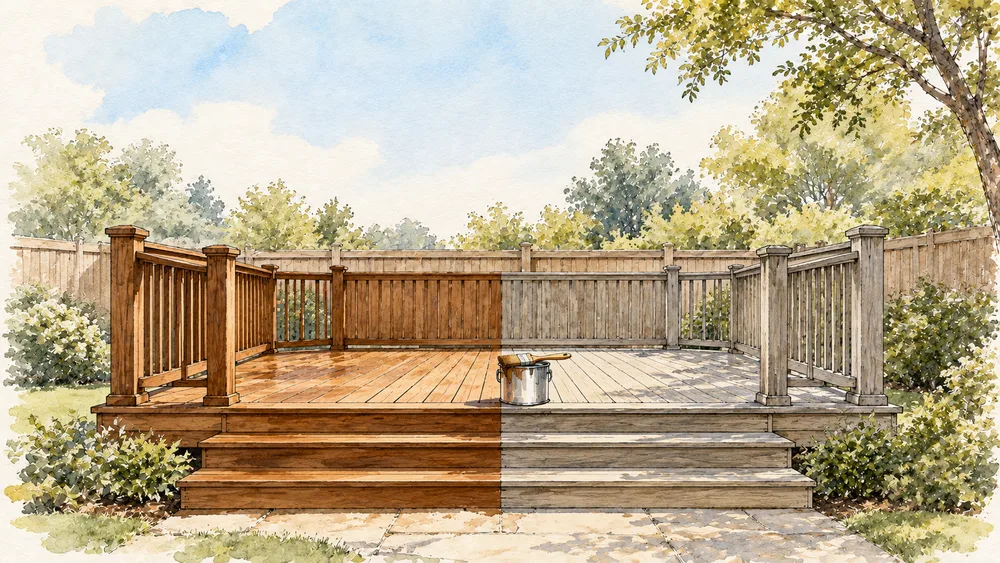
What does deck staining cost in Nashville?
The deck’s condition sets the price. A Nashville painting company publishes $1.50–$2.25 a square foot for a basic re-stain of a surface in good shape, $2.25–$3.25 with standard cleaning and minor prep, and $3.25–$4.50 or more when old stain has to be stripped and sanded away. Applied to two typical deck sizes, that looks like this:
Deck staining by condition and size
| Basic re-stain, $1.50–$2.25/sq ft | Standard prep, $2.25–$3.25/sq ft | Strip and sand, $3.25–$4.50+/sq ft | |
|---|---|---|---|
| 300 sq ft deck | $450–$675 | $675–$975 | $975–$1,350+ |
| 500 sq ft deck | $750–$1,125 | $1,125–$1,625 | $1,625–$2,250+ |
Our math from a Nashville painting company’s published 2026 rates. A budgeting guide, not a quote.
Railings, stairs and gates are extra; see “what changes the price” below. By size alone, the same company publishes $400–$700 for decks under 200 square feet, $700–$1,200 at 200–400 and $1,200–$2,000 at 400–600, with stripping an old solid stain adding $200–$500.
Two published local jobs land inside those ranges: a 475-square-foot deck with two coats of solid stain for $1,625, and a covered porch floor plus a small deck with 11 steps in oil stain for $2,109. National figures bracket the local ones. Angi puts deck staining at $2–$4 a square foot, and HomeGuide separates a simple re-stain ($0.50–$1.50) from cleaning and re-staining ($1.50–$4.00) and full stripping ($2.50–$5.50).
What does it cost to stain a fence in Nashville?
Fences are priced by the linear foot, and the first question is whether the quote covers one side or both. Nationally, one side runs about $4–$14 a linear foot (Angi), with height moving the rate: HomeGuide publishes $2–$7 a foot for a 4-foot fence, $4–$9 for a 6-foot fence and $5–$11 for an 8-foot fence. Fixr’s ranges are similar, $2.25–$10 for one side and $4.50–$20 for both, and a power wash plus stain runs $3.50–$17 a foot.
Locally, one Nashville fence company publishes $10.32 a linear foot for both sides of a privacy fence. Gates are priced separately, nationally $100–$600 for a walk gate and $200–$1,000 for a driveway gate, and most companies carry a minimum charge of $250–$500, so a short run of fence rarely prices out at the per-foot rate.
| Fence | Published figure |
|---|---|
| One side (national) | $4–$14 per linear ft |
| Both sides (national) | $4.50–$20 per linear ft |
| 4-foot fence (national) | $2–$7 per linear ft |
| 6-foot fence (national) | $4–$9 per linear ft |
| 8-foot fence (national) | $5–$11 per linear ft |
| Both sides, privacy fence (Nashville) | $10.32 per linear ft |
| Walk gate / driveway gate (national) | $100–$600 / $200–$1,000 |
Sources: Angi; Fixr; HomeGuide; a Nashville fence company, 2026.
Does staining both sides of a fence double the price?
Not necessarily. Published sources use two different rules, and neither explains its reasoning. Angi prices one side and says adding the second adds about 80%, slightly less than double; Fixr simply doubles its one-side rate, on the logic that both faces need the same coverage.
On a 150-foot fence, Angi’s rule works out to about $1,080–$3,780 for both sides (our math), Fixr’s to $675–$3,000 (our math), and the Nashville fence company’s $10.32 rate to about $1,548 (our math). The base rate matters far more than the rule, so the question to ask every quote isn’t “what’s your multiplier?” It’s “does this price cover one side or both?”
One side or both?
What changes the price of deck and fence staining?
Condition matters most, then railings, stairs, gates and stripping. Railings run $4–$12.50 a linear foot nationally, or $10–$14 with stripping; light sanding adds $1–$1.50 a square foot and heavy sanding $2–$4; the stain itself runs about $20–$120 a gallon depending on type. One published Nashville job shows what scope changes look like in practice: on a $1,475 project, the color change with handrails accounted for $725.
Stripping is where published prices disagree most, by four times or more, from $1–$3 a square foot up to $9–$12. That’s because “stripping” can mean a chemical wash or sanding every board back to bare wood. They’re different jobs sharing one word, so ask what a quote’s stripping step actually involves. One thing that doesn’t change the labor rate is the stain type. No source prices labor differently by stain; the type changes the material cost, not the time.
How decks and fences are measured
Deck
Square feet, plus railings and stairs.
Fence
Linear feet, one side or both.
| Item | Published figure |
|---|---|
| Railings National | $4–$12.50 per linear foot |
| Railings with stripping National | $10–$14 per linear foot |
| Stripping old finish National | $1–$3, $2.50–$5.50 or $9–$12 per sq ft, depending on the source |
| Light sanding / heavy sanding National | $1–$1.50 / $2–$4 per sq ft |
| Color change with handrails | $725 of a $1,475 job |
| Stain itself National | about $20–$120 a gallon, by type |
Sources: Angi; HomeGuide; Fixr, HomeGuide, Angi; Nashville painting company, 2026; Angi, HomeGuide.
Which deck and fence stains last longest?
Generally, the more opaqueopaque How much a stain hides the wood grain, from clear to solid. the stain, the longer it protects. Cabot and Sherwin-Williams both state this rule of thumb, with one important exception: solid stains can peel on a deck. Stains run by opacity, from clear to solid, and the U.S. Forest Products Laboratory explains the exception. Film-forming finishes like paint and solid stain can trap moisture and fail by peeling, while semi-transparent stains don’t blister or peel. A deck’s flat boards take the most weather and foot traffic, which is why manufacturers give decks shorter re-coat intervals than fences.
Manufacturer guidance on re-coating: clear finishes last about one season; semi-transparent stains run 1–3 years on decks and 2–4 years on fences and other vertical surfaces (Cabot, Ready Seal and Armstrong Clark each publish figures in this range); semi-solid adds a year or two over semi-transparent; and solid stains claim five years or more on a sound surface without heavy wear. Sherwin-Williams and Cabot offer a simpler test than any calendar: when water stops beading on the wood, it’s time for another coat.
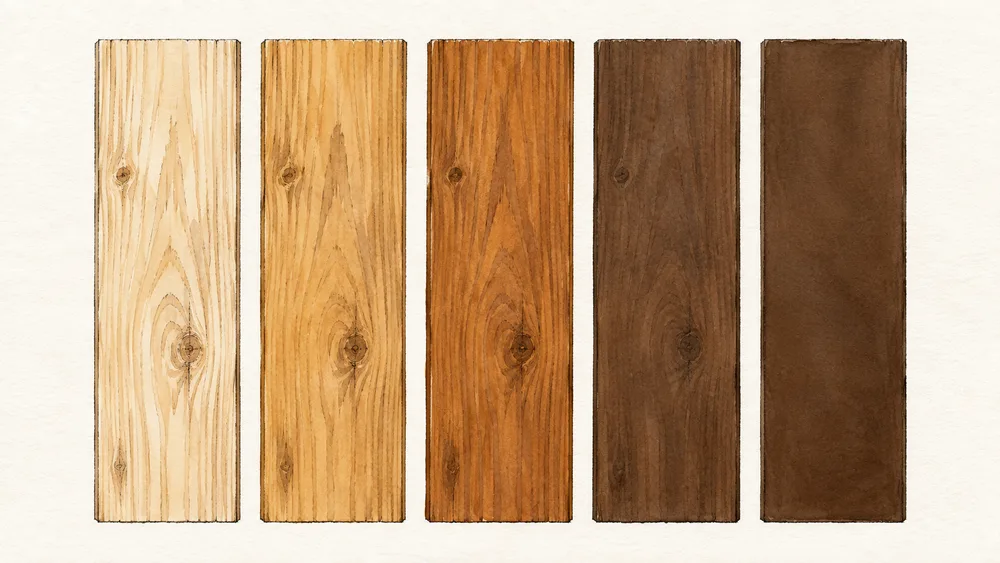
- Clear
- Transparent
- Semi-transparent
- Semi-solid
- Solid
Solid stains can peel on decks.
When can you stain a deck or fence in Nashville?
When the wood is dry and the weather is mild, which in practice means spring and fall afternoons. Most manufacturers call for roughly 50–90°F and no rain for a day or more, and the wood should dry about 48 hours after cleaning before stain goes on. The full job runs clean (every quote should say whether this is included), brighten if needed, let it dry, stain, then let it cure for the rain-free window on the product’s data sheet, anywhere from about an hour to 48 hours depending on the product.
Nashville’s climate draws the boundaries. NOAA’s 30-year averages give September the fewest rainy days (about eight) and October the least rain; average lows in April and October sit just under the 50°F minimum on several data sheets; July averages about 18 days at 90°F or hotter, above most products’ maximums; and late-summer mornings average close to 90% humidity. For the house itself, the same logic applies; see the best time to paint an exterior in Middle Tennessee.
| Product | Temperature | Wood moisture | Rain-free time |
|---|---|---|---|
| Sherwin-Williams SuperDeck (oil, semi-transparent) | surface 50–90°F | dry, not damp | 24 hours |
| Sherwin-Williams SuperDeck (solid) | 50–90°F best, 35°F minimum | ideally 15% or less | 24 hours |
| Cabot semi-transparent | not below 50°F within 48 hours | “absolutely dry” | not when rain is imminent |
| PPG ProLuxe SRD | 50–90°F | 18% or less | 48 hours |
| Armstrong Clark | 50°F to over 110°F | 20% or less | light rain OK 60 minutes after absorbing |
| Ready Seal | no temperature restriction | 12% or less | about an hour |
Source: the manufacturers’ product data sheets, September 2026.
How long should new wood weather before it’s stained?
Ask the stain, not the calendar, because manufacturers flatly disagree. Ready Seal says at least one month (two to three recommended; two to four weeks for cedar). Armstrong Clark says about six months on its website while its data sheet warns against staining wood less than a year old. TWP says four to twelve months. Sherwin-Williams’ homeowner page says at least six months, while its own professional FAQ warns that a long wait lets the wood deteriorate. PPG skips the calendar entirely: stain when the wood is seasoned to 18% moisture or less.
The takeaway is the moisture reading, not the month count. A new deck’s data sheet and a moisture meter settle the question better than any rule of thumb.
| Manufacturer | Wait for new pressure-treated wood |
|---|---|
| Ready Seal | at least 1 month; 2–3 months recommended (cedar 2–4 weeks) |
| Armstrong Clark | about 6 months on its website; “less than 1 year old” not to be stained, on its data sheet |
| TWP | 4–12 months |
| Sherwin-Williams | at least 6 months on its homeowner page, though its professional FAQ warns a long wait lets the wood deteriorate |
| PPG | when seasoned to 18% moisture or less |
Does your HOA control fence stain color?
Often, yes, and cities won’t enforce HOA rules for you, so the check is on you. In Franklin’s Fieldstone Farms, wood privacy fences can stay natural with a clear sealer or be stained an approved natural wood color; boundary fences have a specified solid stain color, and color changes go to the architectural committee. The City of Brentwood notes that neighborhood covenants often go beyond city codes and that it doesn’t enforce them. Check your HOA’s guidelines before you choose a stain color.
How should you compare deck and fence staining quotes?
Make sure each quote measures and prepares the same way:
- The measurements. Decks in square feet (railings and stairs listed separately), fences in linear feet, with height and one side or both stated.
- The preparation. Whether cleaning and brightening are included, and whether old stain is stripped (and what “stripping” means in that quote).
- The extras. Railings, stairs and gates, each listed.
- The product. The stain named, with its opacity and the number of coats.
- The application. Whether a sprayed stain is back-brushedback-brushed Working a sprayed stain into the wood with a brush right after spraying, so it soaks in instead of sitting on the surface., as several manufacturers require.
- The warranty. What it covers, and what it doesn’t (normal weathering and fading are wear, not failure).
Frequently asked questions about deck and fence staining
How often should a deck be re-stained?
Manufacturers of semi-transparent stains generally say every one to three years on a deck and longer on a fence; solid stains last longer. A simpler test: when water stops beading on the boards, it’s time.
Can I paint my deck instead of staining it?
You can, but the U.S. Forest Products Laboratory notes that film-forming finishes like paint and solid stain can trap moisture and peel, while semi-transparent stains don’t peel.
Why is my deck turning gray?
Sunlight breaks down the lignin at the surface of the wood, and rain washes it away, leaving the gray weathered layer. Cleaning and staining restore the color and slow the process.
How long does staining a deck take?
HomeGuide estimates about four hours per 100 square feet, spread over two days for drying. A published Nashville job with a porch floor, small deck and 11 steps took three days.
Is it cheaper to stain one side of a fence?
Yes. Angi estimates the second side adds about 80%, and Fixr doubles the price for both sides.